




News & Stories
2024
News
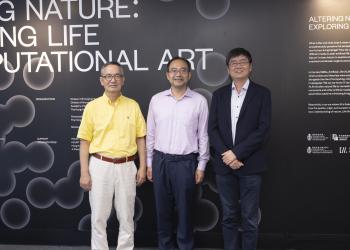
HKUST Kicks off for the first Cross Campus Art-tech Exhibition
The Hong Kong University of Science and Technology (HKUST) held the opening of the exhibition “Altering Nature: Exploring Life in Computational Art” on 30 Oct 2024, which is the first art-tech exhibition in collaboration with Academy of Interdisciplinary Studies (AIS) of HKUST and HKUST (GZ).
HKUST Dean of AIS Prof. QU Huamin said, “The University owns our students some art education and Art Tech integrates different components of the University, making it a platform for showcasing the artworks of students and artists.” He expressed hopes that this exhibition would become an annual event, fostering ongoing collaboration between the Hong Kong and Guangzhou campuses.
Stories
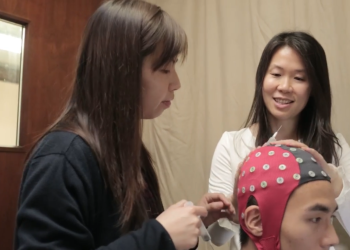
Voices Unheard: The Mindreader who Listens to Thoughts through Cognitive Science
In your daily communications with colleagues, friends, family members, or even strangers, do you ever find it challenging to interpret their unspoken thoughts? For cognitive scientists, there are observable clues that can help decode people’s minds and behaviors—clues that even the individuals themselves may be unaware of. Professor Janet HSIAO, a new Professor at the School of Humanities and Social Science under the prestigious “30 for 30” talent acquisition campaign, is one such scientist uncovering the keys to “reading” minds.“Cognitive science is an interdisciplinary discipline that blends expertise from diverse academic areas, such as artificial intelligence (AI), neuroscience, psychology and linguistics, allowing us to decode people’s minds from various perspectives,” she explained with passion. A computer scientist’s journey into psychology
News
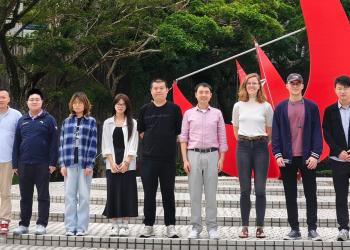
HKUST Research Unveiling the Possible Origin of Life from Deep Earth
A collaborative research team led by Prof. Ding PAN, Associate Professor from the Department of Physics and the Department of Chemistry at the Hong Kong University of Science and Technology (HKUST), has made significant progress in studying the abiotic synthesis and stability of biomolecules in C-H-O-N fluids under deep Earth conditions. This research offers new insights into potential locations for the origin of life. The findings have been published online in the Journal of the American Chemical Society*.
News
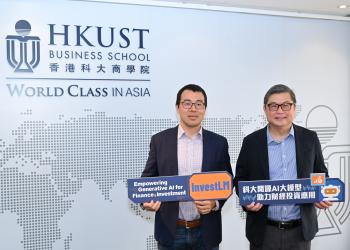
HKUST’s InvestLM Generative AI Platform Launches to Support Financial SMEs Harnessing the Potential of AI Technology
Following the successful development of InvestLM — Hong Kong's first open-source large language model (LLM) for financial generative AI (GenAI) applications, the School of Business and Management of the Hong Kong University of Science and Technology (HKUST Business School) has just launched the InvestLM Generative AI Platform, which will be opened for free registration to the financial services industry in phases. The platform is capable of handling finance-related GenAI tasks and generating human-like responses comparable to those of well-known general-purpose chatbots.
News
HKUST and HKUST(GZ) Major Cross-campus Joint Study Calls for Strategic Update to Boost Hong Kong’s Green Finance Transition
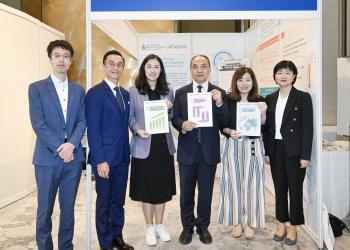
Signifying the major research collaboration across the two HKUST campuses in Clearwater Bay and Guangzhou, a joint research report series by The Hong Kong University of Science and Technology (HKUST) and The Hong Kong University of Science and Technology (Guangzhou) (HKUST(GZ)) analyzes Hong Kong’s progress and outlines steps to enhance its role as a green finance leader. The research team, composed of experts from both campuses, underscores the necessity for Hong Kong to refine its strategies. By doing so, the city could bolster its competitiveness in the international green finance landscape, thereby positioning itself as a preeminent center for green and sustainable bonds.
News
HKUST Introduces City’s Largest Liquid Immersion Cooling Technology for Sustainable AI & Scientific Research
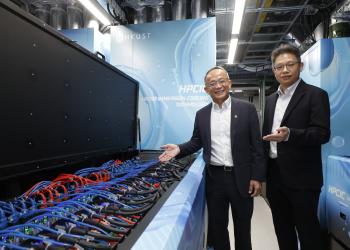
To meet the surging demand for high-power AI research sustainably, The Hong Kong University of Science and Technology (HKUST) has launched the city’s largest Liquid Immersion Cooling system in its new research computing facility. This new technology reduces energy consumption for cooling by over 80% and creates an optimal operating environment that can enhance computing performance at lower temperature.
High Performance Computing (HPC) is vital for scientific research that involves analyzing vast amounts of data or complex algorithms. However, they consume significant electricity, and excessive heat can hinder their performance.
News
16 HKUST scientists secured record high funding from National Natural Science Foundation of China in 2024
A total of 16 scientists from the Hong Kong University of Science and Technology (HKUST) received a record high of funding in 2024, totalling RMB 26.2 million, from the National Natural Science Foundation of China (NSFC).
The funding was granted through three NSFC schemes in support of the University’s research projects on emerging technologies to enhance human wellbeing and facilitate economic and social development – from artificial intelligence, microelectronics, biology and materials science to big data, mathematics and finance.
In the three schemes, four professors garnered funding between RMB 2.8 million to 4 million for each of their projects from the “National Science Fund for Distinguished Young Scholars”. In addition, the “Excellent Young Scientists Fund” awarded RMB 2 million to six professors each, while another six professors received a grant of RMB 300,000 each from the “Young Scientists Fund”.
News
HKUST Welcomes Shenhai Yihao and Jiaolong’s First Visit to Hong Kong
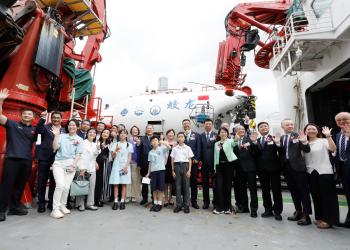
With strong support from the Deep Ocean Affairs Administration of the Ministry of Natural Resources, The Hong Kong University of Science and Technology (HKUST) hosted a welcoming ceremony today for the inaugural visit of Chinese research vessel Shenhai Yihao (Deep Sea No. 1) and the manned submersible Jiaolong to Hong Kong, following the vessel’s successful expedition in the Western Pacific. Co-led by HKUST, the expedition is part of the first international deep-sea metascience program, “Digital Deep-sea Typical Habitats (DEPTH),” backed by the mainland government, with the participation of scientists from various countries.