




News & Stories
2025
News
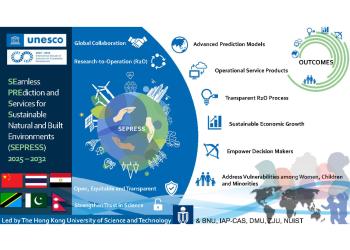
Pioneering Climate Resilience and Sustainability: HKUST Launches Landmark UNESCO-Backed Initiative
The global transdisciplinary "research-to-operation" (R2O) initiative, “Seamless Prediction and Services for Sustainable Natural and Built Environments” (SEPRESS), led by The Hong Kong University of Science and Technology (HKUST), has been endorsed by the United Nations Educational, Scientific and Cultural Organization (UNESCO) as part of its International Decade of Sciences for Sustainable Development (IDSSD). Over the next decade, HKUST’s SEPRESS will spearhead efforts to collaborate with global partners in transforming scientific advancements into tailored solutions that enhance climate resilience and sustainability worldwide, with a particular focus on Least Developed Countries. SEPRESS will achieve this by translating progress in weather-to-climate prediction research into scalable solutions and fostering global partnerships to deliver actionable outcomes.
News
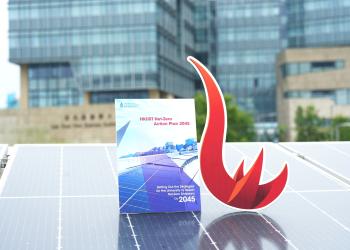
The Race to Zero: HKUST Unveils First Comprehensive Net-Zero Action Plan Among Local Universities
The Hong Kong University of Science and Technology (HKUST) today announces its Net-Zero Action Plan (Action Plan), which is the first among higher education institutions in Hong Kong to have a comprehensive framework with multi-pronged strategies aimed at achieving net-zero emissions by 2045. This plan is supported by a commitment of HK$30 million earned from renewable energy generation to further accelerate research and adoption of innovative decarbonization solutions on campus.
News
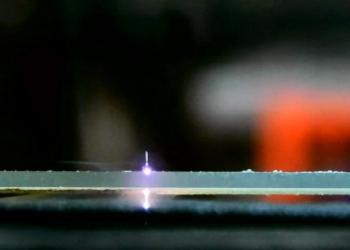
From Beam to Battery: HKUST’s Single-Step Laser Printing Supercharges High-Performance Lithium-Sulfur Batteries
A research team led by Prof. Mitch LI Guijun, Assistant Professor from the Division of Integrative Systems and Design at the Hong Kong University of Science and Technology (HKUST), has developed an innovative single-step laser printing technique to accelerate the manufacturing of lithium-sulfur batteries. Integrating the commonly time-consuming active materials synthesis and cathode preparation in a nanosecond-scale laser-induced conversion process, this technique is set to revolutionize the future industrial production of printable electrochemical energy storage devices. The findings of this study were recently published in the top journal Nature Communications.
News
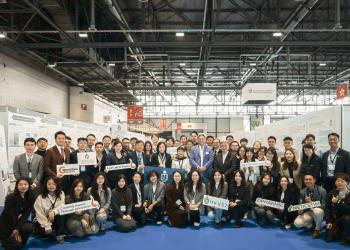
HKUST Achieves Record-Breaking Results at 50th International Exhibition of Inventions Geneva
The Hong Kong University of Science and Technology (HKUST) achieved a record-breaking success at the 50th International Exhibition of Inventions Geneva concluding today. Thirty-seven HKUST teams won a total of 38 awards, including two special grand prizes, 22 Gold Medals (of which seven received Congratulations of the Jury), and multiple Silver and Bronze Medals, showcasing the University’s outstanding performance across different fields including life and health technologies, artificial intelligence (AI) and data science, advanced manufacturing, new energy technologies and aerospace engineering. HKUST outshone other local universities and smashed its own record with this extraordinary haul of awards, reaffirming its status as a powerhouse of creativity and invention.
News
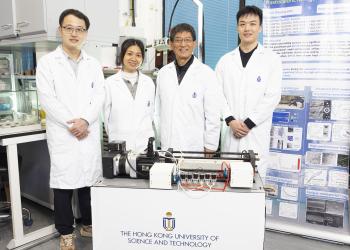
HKUST Develops World’s First Kilowatt-Scale Elastocaloric Green Cooling Device
Researchers at the Hong Kong University of Science and Technology (HKUST) have developed the world’s first kilowatt-scale elastocaloric cooling device. The device can stabilize indoor temperatures at a comfortable 21-22°C in just 15 minutes, even when outdoor temperatures reach between 30-31°C, marking a significant breakthrough toward the commercial application of elastocaloric solid-state cooling technology. The research findings have been published in the leading international science journal Nature, offering a promising solution to combat climate change and accelerate low-carbon transformation of the global cooling industry.
2024
News
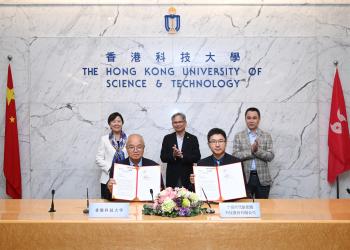
HKUST and CATL Forge Cross-disciplinary Partnership
The Hong Kong University of Science and Technology (HKUST) has recently entered a cross-disciplinary technological innovation partnership with Contemporary Amperex Technology (CATL) and became the first university in Hong Kong to collaborate with the tech giant. This partnership aims to promote research innovation and talent development in the areas of sustainable development and new energy, further expanding HKUST's support to industry partners seeking solutions for energy challenges.
2022

News
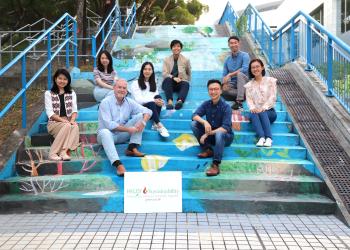
HKUST Develops World’s Most Durable Hydrogen Fuel Cell
Researchers at The Hong Kong University of Science and Technology (HKUST) have developed a new hydrogen fuel cell which is not only the world’s most durable1 to date, but is also more cost-effective, paving way for a wider application of green energy in the pursuit of a carbon neutral world.Hydrogen fuel cell is a promising clean energy option as it generates power by converting hydrogen and oxygen into electricity, with zero emission of carbon dioxide, particulate matters and other air pollutants that may cause smog and other health problems. Despite its environmental benefits and years of development, hydrogen fuel cell was still not widely commercialized. That is because its power generation depends heavily on an electrocatalyst - which is largely made up of the expensive and rare metal platinum.